Front Gate and Bridge
Sakoku, the national isolation, was not so much ‘blocking’ as it was ‘management.’
This was the only passage to enter and exit. Foreigners were not free to leave here, but certain Japanese people (such as officials and interpreters) were free to go in and out.
In this respect, it was not the Japanese but the foreigners who were confined under the Sakoku policy.
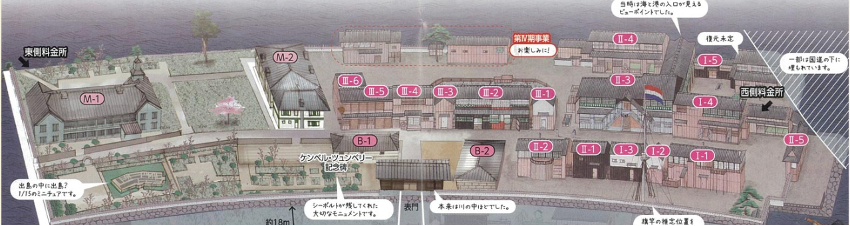
Buildings from the Edo Period (around 1820) Recreated
Phase I (recreated in 2000)
I-1 First Ship Captain’s Quarters
“The sea was the beginning of everything.”
One or two ships from the Netherlands came to Japan every year. The arrival of the first ship was a national event.
In Dejima, the boatmen and merchants resided. All the information and materials from the world arrived here, and after that, they were sent to other parts of Japan. Japanese officials acquired world information only here.
“This means that in the years when the ships didn’t come, Japan had no way to get information from the world.”
I-2 No. 1 Warehouse
This warehouse was mainly used for sugar, which was an extreme luxury at that time. Only people with great power could obtain it. Sugar was not just an ingredient for sweets; it was a symbol of power.
The warehouse was designed to be completely fireproof. This building showcases the foundation stones excavated right here.
I-3 No. 2 Warehouse
This building stored imports, mainly sappanwood (used to make dye). It showcases the trade goods and the intercultural exchanges of that time.
“The culture of color was based on global values even back then.”
I-4 Head Clerk’s Quarters
This was the residence for the Hetlo (head clerk), the deputy chief. Now, the first floor is a shop, and the second floor is used for display and workshop space.
Dejima also maintained the Dutch class-based society. The Dutch obeyed strict rules on ranking, just like the samurai world in Japan.
“To them, Dejima represented not only a place for trade but also a miniature of their ordinary national system.”
I-5 Kitchen
“Cultures mix first in the kitchen.”
This kitchen was for cooking meals for the Dutch. Western-style food was prepared by the Japanese, using local Japanese products. The Japanese officials and interpreters in Dejima took samples of rare European cuisine home and enjoyed them with their families.
Today, there are some foods in Nagasaki that are thought to have originated in the Netherlands.
“Food culture is the shortest way to learn about a foreign culture.”
Phase II (recreated in 2006)
II-1 No. 3 Warehouse
This warehouse stored various imports, including sugar. The interior of this building has been recreated to reflect its original atmosphere.
“Dejima was a place to organize and manage a variety of international trade goods. Smuggling was a felony.”
II-2 Dutch Clerk’s Quarters (Western Studies Pavilion)
This building was used by Dutch clerks responsible for bookkeeping and composing documents. The displays showcase information on Western science, such as medicine, physics, and astronomy.
“This was the gateway through which Western science was introduced to Japan. This was the only place where advanced science from outside Japan could be learned.”
II-3 Kapitan’s Room (Chief Factor’s Residence)
This was the residence and office for the Kapitan, functioning as the headquarters in Dejima. It also served as a guest house for Daimyo (feudal lords) and top-class officials. The first floor showcases the history and daily life of Dejima, while the second floor is a recreation of the Kapitan’s lifestyle. He traveled to Edo once every few years to have an audience with the Shogun.
“Although the Kapitan held the highest rank on the Dutch side, he was forced to be subordinate to every Japanese samurai. He might have been the European who made the most bows to the Japanese.”
II-4 Japanese Officals’ Quarters (Otona’s Room)
The top Japanese officials are called “Otona” in Dejima.
Dejima was ruled by the Japanes selected from among the Nagasaki merchants.
“The boss of Dejima was not Dutch.”
II-4 Japanese Officials’ Quarters (Otona’s Room)
The top Japanese officials in Dejima were called “Otona.” Dejima was ruled by Japanese officials selected from among the prominent merchants of Nagasaki.
“The boss of Dejima was not the Dutch Kapitan.”
II-5 Sea Gate
This was the iconic structure through which all trade goods and cultures of both Europe and Japan first entered and exited. The southern gate was used for imports, while the northern gate was used for exports. Because the flow of international trade was so visible here, the gate held significant ideological importance.
Phase III (recreated in 2016)
III-1 No. 16 Warehouse
This warehouse stored cloves and other spices.
In those days, cloves were as valuable as gold. Spices, including cloves, were a significant reason why the Age of Discovery began in Europe.
“Spices might have been a ‘hot stimulation’ that added a taste for exploration to people’s minds.”
III-2 Dutch Clerk’s Quarters
This building displays Dejima’s role as a commercial and cultural bridge between Japan and the outside world.
Ⅲ-3 No. 14 Warehouse
This building was used as a warehouse for sugar, but now it showcases the excavation, the construction of Dejima, and the bridge connecting it to the town of Dejima.
“Dejima was an artificial island, built with advanced technologies. It was a proto-type of the city development.”
III-4 Japanese Officials’ Office (Otona’s Room)
This building was a guard point to check the comings and goings at Dejima’s front gate. The guard was in operation 24 hours a day.
III-5 Assistants’ Room (Kumigashira’s Room)
The duty of the assistants was to weigh and pack copper bars for export. In the Edo period, copper was the most important export. It is estimated that during that period, especially in the late 17th and early 18th centuries, Japan produced the largest amount of copper in the world.
“It showcases the authentic atmosphere of a workplace. It makes visitors feel as if they are watching a supervisor overseeing the laborers working diligently.”
III-6 Copper Warehouse
The interior of this warehouse has been recreated, featuring piles of boxes filled with copper bars.
“Although Japan now suffers from a lack of natural resources, the Edo period saw Japan as one of the world’s richest countries in terms of natural resources.”
Late Edo Period (1860s) Restored Buildings
B-1 Old Stone Warehouse (Archaeology Pavilion)
This warehouse was used by one of Japan’s first German companies at the end of the Edo period. It displays artifacts unearthed during recent excavations. Dejima is still in the middle of an ongoing excavation process.
B-2 New Stone Warehouse (Information Office and Dejima Theater)
This warehouse was used by one of Japan’s first German companies at the end of the Edo period. It displays artifacts unearthed during recent excavations. Dejima is still in the middle of an ongoing excavation process.
Buildings from the Meiji Period
M-1 Former Dejima Protestant Seminary
Constructed in 1878, this is the oldest Protestant seminary in Japan. Even after the end of the national isolation policy, Dejima continued to play an important role as a center for education and religion.
M-2 Former Nagasaki International Club
It was constructed in 1903. Currently, the first floor serves as a restaurant, and the second floor displays artifacts from the foreign settlement era.
“Following the establishment of the Meiji government, which ended samurai rule, Nagasaki relinquished its role as Japan’s sole international trade hub. However, it continued to welcome many foreign visitors and evolved into a truly international city.”