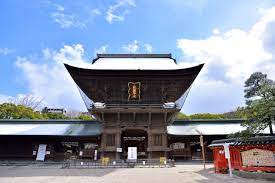
Hakozaki Shrine
Hakozaki Shrine is one of Japan’s three major Hachiman shrines. During the Mongol invasions, Emperor Kameyama prayed here for “the surrender of the enemy,” and a large statue of him now stands within the shrine grounds. Since the successful defense of Japan against the Mongols, the shrine has been revered as a guardian for sailors and a protector against foreign invasions. Every September, it hosts the Hōjōya Festival.
More about Shinto Shrine , Click here.
More about Hachiman Shrine , Click here.
Hojoya Festival
At Hakozaki Shrine, the festival is called Hōjōya, rather than Hōjōe, the more common term. Originally, Hōjōe was a Buddhist ceremony in which captive animals were released to express compassion for all living beings. Today, it has become a lively festival enjoyed by many.
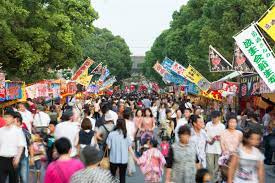
Hōjōya at Hakozaki Shrine, held from September 12th to 18th, is one of Hakata’s three major festivals. The road leading to the main hall is lined with hundreds of stalls, creating a vibrant atmosphere that draws large crowds. In the past, attractions such as haunted houses made it feel much like a traditional country fair in the United States.
During the festival, the shrine sells nostalgic toys such as champon, a glass toy that makes a sound when blown, and ohajiki, small clay marbles. Fresh seasonal ginger is also a popular item.
A related local saying is “Nashi mo kaki mo Hōjōya.” Literally, it means “Pears and persimmons are good in Hōjōya,” but it’s used humorously as a response to the Hakata dialect word “Nashite?” meaning “Why?” The phrase plays on the word nashi (“pear” or “nothing”), and is roughly equivalent to saying “Never mind” or “Don’t ask.”
More about Japanese Festivals , Click here.
Kashii Shrine
Located in Kashii, in Fukuoka’s Higashi Ward, Kashii Shrine enshrines Emperor Chūai and Empress Jingū. The shrine originated in ancient times as an altar built by the empress at the burial site of Emperor Chūai, who died there while leading an expedition against the Kumaso, a powerful tribe in Kyushu.
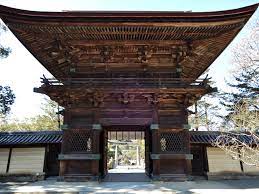
Along the approach to the shrine, you will find a komainu (guardian lion-dog) with its mouth closed. Touch this komainu, called “Un,” and then walk back onto the white stone pathway. When you stand there and look back toward the wooden gate, you’ll notice that the shapes of the gate and the torii beyond form the kanji character “開” (read kai), meaning “open.” Together, “Un” and “Kai” form “Kaiun,” which means “Good Luck.”
More about Shinto Shrine , Click here.
Keiseki Shrine
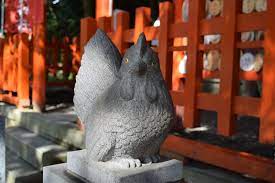
Keiseki Shrine is located within the grounds of Kashii Shrine. The name Keiseki literally means “Chicken and Stone,” and it is a very rare shrine dedicated to chickens. According to legend, a chicken once died and turned into a stone, and a Buddhist monk, moved with compassion, built an altar for it. Because chickens do not crow at night, the shrine is believed to help prevent babies from crying after dark. The ema (prayer boards) are egg-shaped, adding a charming and playful touch.