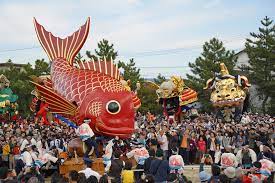
Karatsu Kunchi
Karatsu Kunchi is the vibrant annual autumn festival of Karatsu, held from November 2nd to 4th. The highlight of the event is the procession of magnificent festival floats, known as hikiyama, pulled through the streets to energetic shouts of “Enya, Enya!” and “Yoisa, yoisa!”
The festival traces its origins to the early 17th century, with its current form heavily influenced by Kyoto’s Gion Festival. Today, 14 elaborately crafted floats are preserved, each designated as an Important Tangible Folk Cultural Property. In 2016, Karatsu Kunchi was inscribed on the UNESCO Representative List of the Intangible Cultural Heritage of Humanity as part of Japan’s “Yama, Hoko, Yatai” float festivals.
English Official Site about Karatsu: Karatsu https://www.karatsu-kankou.jp/en/
Japanese Official Site (No English Page): Karatsu Shrine https://www.karatsu-jinja.org/kunti
Hikiyama Floats
The Hikiyama floats are constructed using a traditional dry lacquer technique. This intricate process begins with a clay base, which is then covered with approximately 200 layers of Japanese paper and lacquer. This layering is repeated seven or eight times to build a strong yet lightweight structure. The final decoration includes detailed paintings and applications of gold or silver leaf.
Each finished float is mounted on a wheeled cart and pulled through the streets during the festival. Dozens of participants use two long ropes, each measuring about 100 meters, to maneuver the float in a lively and dynamic procession.
1 The Red lion (赤獅子) built by the Katana-machi district (1819)
2 The Green lion (中町の青獅子) built by the Naka-machi district (1824)
3 The Turtle and Urashima Taro (カメと浦島太郎) by the Zaimoku-machi district (1841) It was not Taro originally but a gem on the turtle when it was first built.
4 Samurai Minamoto Yoshitsune’s Kabuto (源義経の兜) by Gofuku-machi (1844)
5 The Sea bream(鯛) by Uoya-machi (1845)
6 The Phoenix-shaped ship (鳳凰丸) by Oishi-machi (1846)
7 The Flying dragon (飛龍) by Shin-machi (1846)
8 The Golden lion (金獅子) by Hom-machi (1847)
9 ‘Takeda Shingen’s Kabuto (武田信玄の兜) by Kiwata-machi (1864)
10 ‘Uesugi Kenshin’s Kabuto (上杉謙信の兜) by Hirano-machi (1869)
11 The Drunken ogre on Minamoto Yorimitsu’s Kabuto (酒呑童子と源頼光の兜) (1869)
12 The Lion on an orb (珠取獅子) by Kyo-machi (1875)
13 The Tiger-headed orca(鯱) by Kako-machi (1876)
14 The Boat of seven treasures (七宝丸) by Egawa-machi (1876)