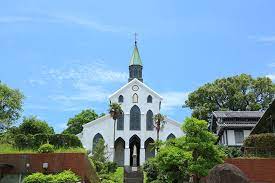
Oura Tenshudō is a Gothic-style church representing medieval European architecture, built for foreign residents in the Nagasaki Settlement area, which was established after the country opened to the outside world at the end of the Edo period.
More about Persecution of Christianity in Japan , Click here.
Some of the stained glass windows decorating the chancel are approximately 100 years old.
The church is also dedicated to the 26 Japanese saints martyred just before its construction, and its façade was built facing Nishizaka, the site of their martyrdom.
The design was led by French missionaries Fathers Furet and Petitjean, and construction was carried out by Koyama Hidenoshin (later renamed “Shūhide”) of Amakusa.
Construction was completed at the end of 1864, with the inaugural celebration held in February of the following year.
Shortly afterward, in March, a hidden Christian from Urakami visited the church and confessed his faith, leading to an unprecedented “discovery of believers” in the history of world religions.
Additions and renovations in 1875 and 1879 altered the layout and exterior design, replacing the wooden outer walls with brick. However, the main interior spaces have been preserved as they were when the church was first built.
It was designated a National Treasure in 1933. After restoration from damage caused by the atomic bomb was completed, it was again designated a National Treasure in 1953 as the oldest surviving church building in Japan. It is also part of the “Hidden Christian Sites in the Nagasaki Region,” registered as a UNESCO World Heritage site in 2018.