Tojo System of Satsuma Domain
This area was historically governed by the Shimazu family as the regional capital. During the Edo period, the Satsuma domain implemented an administrative system known as the Tōjō, dividing its territory into 113 small districts. Chiran was one of these districts.
More about Japanese Castles , Click here.
This former samurai district is characterized by its beautiful, box-like gardens. Under the Satsuma domain’s Tōjō system, samurai were stationed across 113 designated areas known as fumoto. Each district was designed with defensive features to deter invasion.
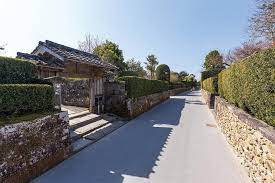
Stones of the Walls
High-ranking families used large, carefully square-cut stones that fit together precisely, demonstrating their wealth and access to skilled stonemasons.
Lower-ranking families used rounded, uncut fieldstones that were easier and cheaper to assemble, though still effective for building strong walls.
Roofs of the Gates
Double roofs show the family was high-ranked.
Path Not Straight
The Inumaki (Japanese yew, Taxus cuspidata) was used as a defensive hedge on stone walls. Its soft, flexible branches made it impossible to climb or gain footing, and its dense foliage provided an effective visual barrier, concealing the houses behind it.
Inumaki Trees
The Inumaki (Japanese yew, Taxus cuspidata) was used as a defensive hedge on stone walls. Its soft, flexible branches made it impossible to climb or gain footing, and its dense foliage provided an effective visual barrier, concealing the houses behind it.
Syakkei, Borrowed Scenery
The background scenery far behind the garden is used as one of the components of the design of Japanese gardens. In Chiran Samurai Residence Area, the view of Mt. Hahagatake.
More about Japanese Houses , Click here. More about Japanese Gardens , Click here.
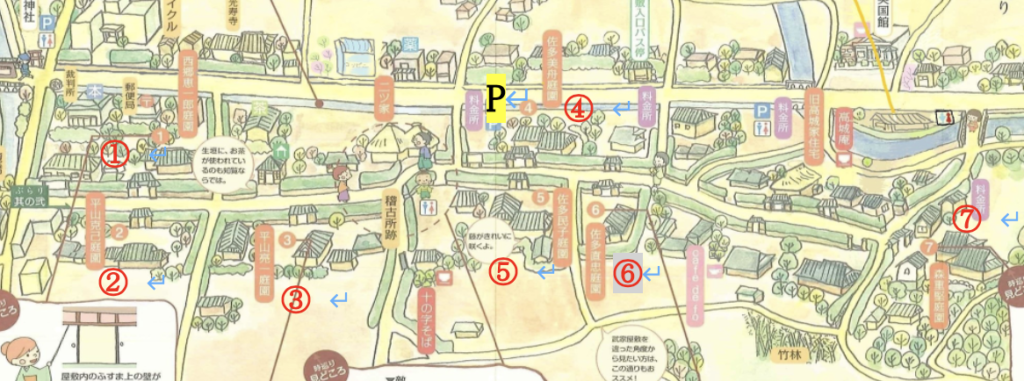
Seven Houses
1 Saigo Keiichiro’s
In the southeast corner, a dry waterfall made of rocks represents a high peak. The Inumaki (Japanese yew) hedges, trimmed to varying heights starting from the peak, represent distant mountains. This garden is called “Crane and Turtle.” The crane rock is in a higher position, and the turtle rock rests on the ground as if floating on water. The rocks and Satsuki azaleas are arranged in perfect harmony.
2 Hirayama Katsumi’s
This garden uses Mount Hahagatake as a beautiful backdrop. In the north, a rock arrangement is built to represent an imaginary high peak, and the ridge of the Inumaki hedges extends the line of Mount Hahagatake’s ridge. Every part of this garden is regarded as an ideal representation of harmony and beauty. It evokes the image of a small uninhabited island in the ocean with green land beyond the sea.
3 Hirayama Ryoichi’s
This garden contains no rock arrangements and consists entirely of plants. Inumaki hedges represent three high peaks, and the Satsuki azaleas in front symbolize tsukiyama (artificial hills). Mount Hahagatake is used as the background. This garden is a masterpiece of simplicity.
4 Sata Mifune’s
This garden is believed to have been constructed around 1751. It is the most ornate and largest of the seven gardens. A dry waterfall was created using rocks, with a stone lantern placed on the upper part of the artificial hill (tsukiyama) and a rock arrangement on the lower, flat area. When you enter the gate and turn right toward the garden in front of the study, you can imagine a waterfall rushing down the scene.
5 Sata Tamiko’s
Large, distinctive rocks are stacked to represent a deep mountain valley. The scene invites you to imagine sailing in a boat along a stream, watching a hermit wizard beckoning to you. The rocks are made of tuff, a soft stone that could be easily cut and transported by cows and horses.
6 Sata Naotada’s
When you pass through the gate, you will see a stone slab known as the Byōbu Rock(Folding Screen Rock). Samurai residences often featured such rocks for both defensive purposes and to display the family’s prestige. The garden was constructed between 1741 and 1744. By incorporating the view of Mount Hahagatake and using carefully arranged rocks to form an artificial hill (tsukiyama) with a large central stone representing a waterfall, the garden resembles a refined ink-wash painting.
7 Mori Shigemitsu’s
The Mori family were high-ranking vassals of the Shimazu clan. Their residence and storehouse were constructed in 1741. The garden features a gracefully curved pond with unusually shaped rocks representing nearby mountains and a peninsula. On the opposite side, a rock with a hole symbolizes flowing water. The rock to the right of the entrance serves as a key element, symbolizing distant clouds over the mountains.