Japanese Official Web Site: Tocho Temple (No English Page) https://www.tochoji.net
General Information
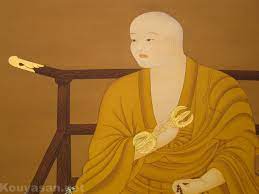
Tochoji Temple, the home of the Fukuoka Daibutsu, is the head temple of the Shingon sect in Kyushu. It was founded in 806 by the renowned Buddhist priest Kukai, making it the first esoteric Shingon temple and one of the oldest holy sites in Japan. Its name reflects the wish for the Shingon teachings to spread widely and endure.
After completing his studies in Tang-dynasty China, Kukai returned to Hakata and purchased a hut to store the statues and sacred texts he brought back. This hut, located in what is now Furukado Machi, was later converted into the temple.
The original temple was destroyed by fire during the conflicts of the Eiroku and Tensho periods. It was later relocated and rebuilt at its current site by Kuroda Tadayuki, the second lord of the Fukuoka domain, who established it as his family’s funerary temple.
Tochoji Temple holds a position of rich historical significance in several major pilgrimage routes: it is the first temple on the Kyushu 88-temple Pilgrimage, one of the 36 holy places of the Fudomyo-o in Kyushu, and the 22nd of the 24 holy places of Jizo in Kyushu.
More about Buddhism , Click here.
The Big Buddha
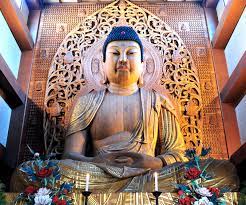
The Great Buddha (Daibutsu) at Tochoji Temple, known as the Fukuoka Daibutsu, is a prestigious and awe-inspiring statue well worth seeing. Construction of the statue took four years, from 1988 to 1992, and it is one of the largest seated wooden Buddha statues in Japan.
The statue stands 10.8 meters high, a number which symbolizes the 108 earthly desires (Bonnō) that are said to cause human suffering. It is a seated figure weighing 30 tons, crafted from hinoki cypress wood.
Behind the statue is a magnificent golden halo called a Kouhai (“light back”), which rises 16.1 meters. The Kouhai is intricately carved with groups of deities, including the Seven Gods of Fortune and the Thirteen Buddhas. Its surface is also enshrined with approximately 500 small, dot-like Buddha figures. The fine artistry of the Kouhai makes it a masterpiece well worth admiring alongside the main statue.
More about Buddha Statues , Click here.
Hell Walk
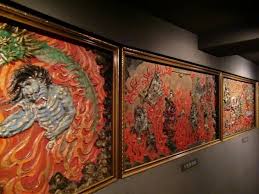
The Big Buddha pavilion is two storied, with the Statue on the second floor. Its pedestal is installed with the entrance to Hell Walk. This is free of charge. This Hell Walk has the meaning of experiencing the afterlife, rebirth and liberty from dirtiness and worries. Soon after you go through the entrance, you will see very elaborate eight pictures of hell. Going straight along, you will be surrounded with total darkness, where even adults may feel scared. The handrail installed there is the only help to go through there, just like God is guiding you.
When you go through holding this handrail, in darkness you have a chance to touch “the Ring of Light.” If you find and touch it, you are guaranteed to go to Heaven. If not, still going along in the darkness, you will reach the exit and see the picture of Heaven, and this is the end of the walk.
Hell Walk is not so long, but when you see the light from the exit, you surely feel relieved. This is an unseal experience, so it is very popular among the visitors.
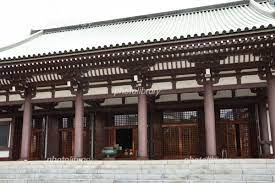
Main Pavillion
The main pavilion enshrines Buddhist statues believed to have been carved by Kukai himself. This sacred triad consists of Senju Kannon (Thousand-armed Kannon), Fudomyo-o, and a statue of Kukai. These three statues are designated as Important Cultural Properties.
Also housed within the main pavilion is the temple’s principal image—a hidden statue of the Eleven-faced, Thousand-armed Kannon. Although it is only 87 centimeters tall, it dates back to the Heian period and is also designated as an Important Cultural Property.
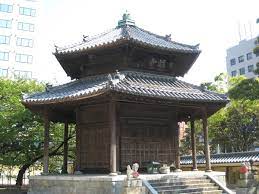
Rokkakudo
To the left of the main gate stands the Rokkakudo, a hexagonal hall built in 1842 (the 13th year of the Tenpo era). It was commissioned by a Hakata merchant named Bungoya Eizo, who gathered funds from merchants west of Nagoya, and constructed by the 8th-generation master shrine carpenter, Ito Heizaemon.
The hall features a double-layered, thatched (kaya) roof. It is now designated as a Municipal Tangible Cultural Property.
Grave Yard for Kuroda Family
The Kuroda family ruled the Chikuzen Domain, which corresponds to modern-day northern Fukuoka Prefecture.
To the left of the main pavilion lies their gravesite, with the Rokkakudo hall marking its entrance. Beyond the Rokkakudo, a group of five-tiered stone pagodas (gorinto) are arranged in a line. From west to east, they are the tombs of Tadayuki, Mitsuyuki, and Harutaka.
Tadayuki’s tomb is notably the second tallest of all individual grave pagodas in the country. The entire gravesite remains in its original state and was designated as a Municipal Historic Site in 1995 (the 7th year of Heisei).
Five Storied Tower
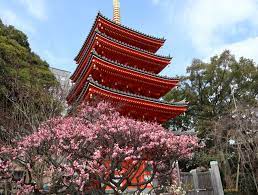
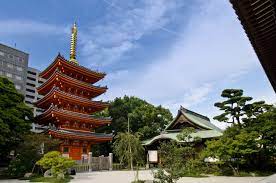
To the left of the main pavilion stands a beautiful five-storied pagoda, constructed entirely of hinoki cypress wood. Completed in the spring of 2011 (the 23rd year of Heisei), it stands 26 meters tall.
The roof of the top story is crowned by a sorin (a metal spire) named “Kuirin,” meaning “Nine Rings.” One of these rings, a bowl-shaped segment, is said to contain bone fragments of the Buddha, reputedly brought back from China by Kukai.
The interior of the first story is beautifully decorated with paintings of the Dainichi Nyorai (the central Buddha in Esoteric Buddhism) and motifs of flowers and birds, created by the Japanese-style painter Toriyama Rei.
Next to the pagoda grows a beautiful shidare-zakura (weeping cherry tree), which offers a picturesque view in every season. The entire scene is highly photogenic.
More about Five Storied Pagoda , Click here.