General Information
Dejima is an artificial island built as a trading port for Western nations during the Edo period. During Japan’s approximately 200 years of national isolation, it served as the country’s only window to the West. The island was later reclaimed during the Meiji period. Today, it is designated as a National Historic Site as the remains of the Dejima Dutch Trading Post, and Nagasaki City has been carrying out restoration work to preserve its historical significance.
Initially, Portuguese traders lived on Dejima. However, in the year after its completion, a Christian-led rebellion broke out in Shimabara and Amakusa, causing the shogunate to sever ties with the Portuguese. In 1639, the Portuguese were banned from landing in Japan, leaving the island uninhabited just three years after its completion.
During the Edo period, the Netherlands and China were the only countries permitted to trade with Japan. To control the spread of Christianity and prevent smuggling, the Dutch were restricted to Dejima, while Chinese traders were accommodated in designated Chinese residences.
History More about National Isolation , Click here.
The shogunate built an artificial island to house Portuguese residents of Nagasaki and control their activities, aiming to prevent the spread of Christianity. Twenty-five wealthy Nagasaki merchants financed its construction.
Portuguese, Dutch, British, and Chinese traders competed for access to Japan. In 1637, the Shimabara Rebellion increased shogunate suspicion toward the Portuguese, who were subsequently expelled. The Dutch, having supported the shogunate during the rebellion, were then granted a trade monopoly.
After the Portuguese were expelled from Dejima in 1639, the island stood empty. Then, in 1641, the Dutch Trading Post was moved to Dejima from Hirado. For the next 218 years, until Japan reopened in the Ansei era, Dejima remained Japan’s only official window to the Western world.
During the early Edo period, key imports from the Dutch included raw silk and red iron oxide, while silver was the primary export. By the mid-Edo period, imports shifted to include woolen cloth (such as raxa), velvet, pepper, sugar, glassware, and books. Exports then consisted mainly of copper, camphor, porcelain, and lacquerware.
After Japan reopened, Nagasaki was modernized as a trading port. As part of this effort, Dejima was eventually reclaimed and absorbed into the expanding city.
Each House
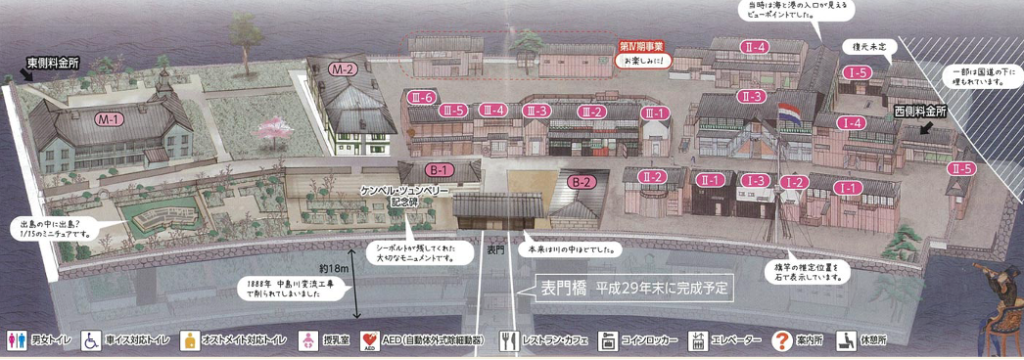
Section I
- I-1 The Captain’s House of the First Ship
This house was used by captains and house clerks. The first floor has a reproduced dirt floor for storage, while the second floor features a living room with tables and beds. - I-2 The First Warehouse
This warehouse was used for storing imported sugar. Warehouses were built with thick earthen walls. It displays the reproduction process and the building’s foundation stones. - I-3 The Second Warehouse
This warehouse was used for storing sobok and sappan wood (a dyeing material). It displays various imports and exports that passed through Dejima. - I-4 Hetoru House
This was the residence of the Hetoru, the Vice-Headmaster. The first floor is a museum shop selling Dejima goods, and the second floor is used for special featured exhibitions. - I-5 Cooks’ House
House clerks ate their meals on the second floor of the Kapitan’s house. This was the kitchen where those meals were prepared. Japanese interpreters and samurai clerks who visited Dejima were said to be very happy to receive rare Western food here.
Section II
- II-1 The Third Warehouse
This warehouse represents the storehouses of the time and stored various export goods. - II-2 Secretaries’ House
This house was for Dutch secretaries who kept records. It introduces Dutch learning (Rangaku), which first entered Japan through Dejima. - II-3 Kapitan House
This was the residence and office of the Kapitan, the head of the Dutch Trading Post. It is the largest building in Dejima and was also used as guest quarters for Japanese government clerks and samurai lords. The first floor displays the history and daily life of Dejima, while the second floor illustrates the life of the Kapitan. - II-4 Otona House
This was the house for the Otona, the Japanese officials who managed trading affairs. The Otona were chosen from the townspeople who built Dejima. The first floor introduces their work. - II-5 Water Gate
This is a symbolic structure representing the introduction of Western and Japanese cultures, knowledge, and trade. There are two entrances: the south entrance for imports and the north entrance for exports.
Section III
- III-1 The Sixteenth Warehouse
This warehouse was used for storing cloves. - III-2 Dutch Secretaries’ House
This building clearly shows how Dejima was connected with the world and other parts of Japan through trade and cultural exchange. - III-3 The Fourteenth Warehouse
This warehouse was used for storing sugar. It exhibits items excavated from beneath the warehouses, explains the construction process, and details the bridges that connected Dejima to Nagasaki town. - III-4 Otona Office
This was the office where the Otona were stationed. - III-5 Kumigashira House
The Kumigashira were assistants to the Otona. Their duties included measuring and wrapping copper. - III-6 Copper Warehouse
This warehouse displays how copper, the most important export, was stored. A video presentation introduces the history of Japan’s connection with the world through copper.
Section B
- B-1 Stone Warehouse
This stone warehouse dates back to the end of the Edo period. It displays archaeological items excavated from Dejima. - B-2 New Stone Warehouse
Section M
M-2 The Former Nagasaki Society Club
Built in 1903, this club was a social venue for Japanese people and foreigners living in Nagasaki. The first floor is a restaurant serving Nagasaki cuisine, while the second floor exhibits artifacts from the foreign settlement era.
M-1 The Former Theological School
This is the oldest Christian theological school in Japan, built in 1878.