Japan Sumo Association Website
History
Sumo dates back to the 8th century. It originated as a contest of strength.
Originally a ritual held in the imperial court during the Heian period to predict the harvest, sumo later gained popularity among the samurai class in the 13th century as a form of martial art. During the Edo period (1603-1867), it evolved into popular entertainment for the common people. It continued to develop, becoming more refined and stylized until the modern, highly organized tournament system was established.
Grand Tournaments
The grand sumo tournaments broadcast on TV are major public events featuring professional wrestlers. The spectacle is overwhelming, as these huge men—weighing about 150 kilograms on average—collide barehanded while the audience cheers loudly for their favorites. As of the latest data, there are approximately 600 professional wrestlers.
These grand tournaments, called ‘Ō-zumo’ (Grand Sumo), are held six times a year, with each tournament lasting 15 days.
Ranks
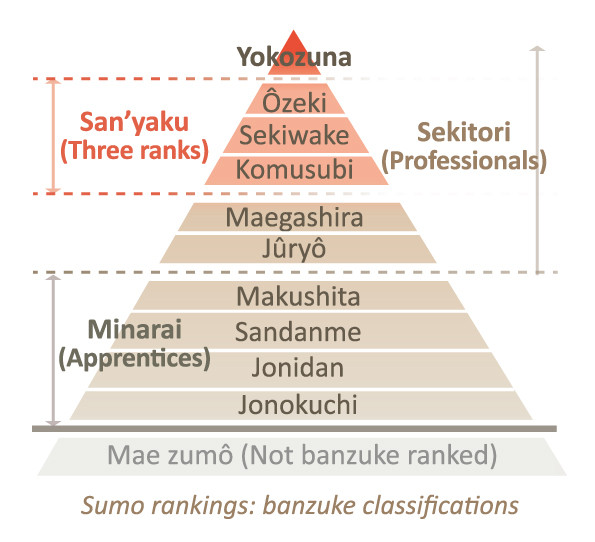
The wrestlers are ranked in a strict hierarchy based on the results of the previous tournament, with the new rankings announced just before the next one begins. The highest rank is Yokozuna (Grand Champion), followed by Ōzeki, Sekiwake, Komusubi, and Maegashira. These ranks constitute the top division, known as Makunouchi. Below them are the Juryo, Makushita, Sandanme, Jonidan, and Jonokuchi divisions. Wrestlers in the Makunouchi and Juryo divisions are considered full-fledged professionals and are called Sekitori.
All sumo wrestlers are collectively known as Rikishi. Each rikishi belongs to a training stable, called a heya or sumo-beya. A stable typically consists of three to twenty rikishi of various ranks (the number is flexible). Lower-ranked rikishi live full-time at the stable, where they train and perform domestic duties. The stable is run by a master, the shisho, who is a former wrestler. The shisho oversees all daily operations and closely monitors the progress of every rikishi in his care. A key rule is that rikishi from the same stable never compete against each other in official tournaments.
Sumo Bout Ring
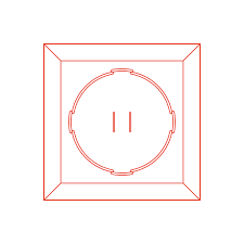
The sumo match takes place on a dohyo, a ring approximately 15 feet in diameter, raised about 2.5 feet on a massive clay platform. The surface is sprinkled with sand, and the boundary is defined by tawara—tightly wound straw bales that sit about 3 inches high. A new, consecrated dohyo is built for each tournament.
Overseeing the match are five judges (shinpan), dressed in black kimonos and seated around the ring. These judges are all former wrestlers. A referee (gyoji), wearing an elaborate kimono, officiates from inside the ring. At the bout’s conclusion, the gyoji points his war fan (gunbai) toward the winner.
For particularly close matches, any of the five shinpan can dispute the gyoji’s call, triggering a ringside conference known as a mono-ii. During the mono-ii, the officials gather in the ring to deliberate, and in modern times, they use television instant replays to help determine the final outcome.
Manners in Sumo
Dohyo-iri / Ring Entering Ceremony
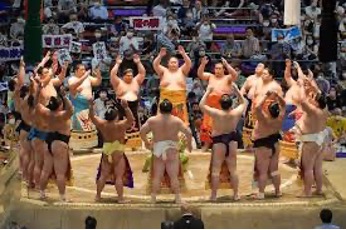
The ring-entering ceremony (dohyo-iri) is performed exclusively by wrestlers in the makunouchi divisions. The wrestlers from the east and west sides take turns performing this ceremony in succession.
Yokozuna Dohyo-iri
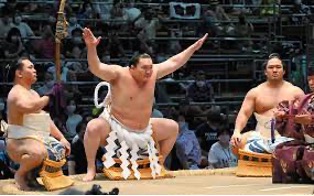
The yokozuna performs his own distinctive ring-entering ceremony (dohyo-iri). The two main styles, Unryu and Shiranui, are named after the legendary wrestlers Unryū Kyukichi and Shiranui Koemon. During the ceremony, the yokozuna is accompanied by two attendants: the tachimochi(sword bearer) and the tsuyuharai (dew sweeper), who clears the path.
Yumitorishiki / Bow-Twirling Ceremony
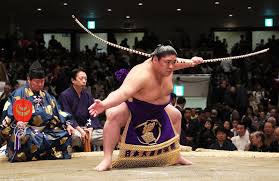
The bow-twirling ceremony (yumitori-shiki) is performed at the end of each day of the grand tournament (honbasho) by a designated wrestler called the yumitori. This wrestler is typically from the makushita division and is often a member of a yokozuna‘s stable.
Torikumi /Bout Procedure
The Sumo Pre-Bout Ritual
- Waiting: A rikishi leaves the dressing room, walks down the passageway, bows before the dohyo, and sits in the waiting area. When passing a judge or another waiting wrestler, he holds the sagari (hanging cords) of his mawashi and performs a slight, vertical hand gesture as a sign of respect.
- Calling In: He stands when his name is called, steps onto the dohyo, and bows to his opponent at the nijiguchi (the entrance point to the ring).
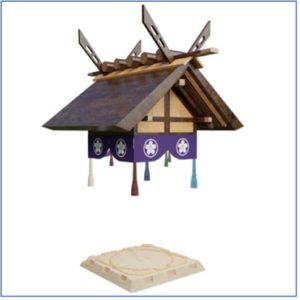
- Directional Stomping (Shiko): Different-colored tassels hang from the roof, each representing a cardinal direction. The wrestler from the East stands under the red tassel, and the West under the white one, where he performs a leg-stomping exercise called shiko.
- Water Purification (Chikara-mizu): Squatting under his tassel, he receives a scoop of water from the winner of the previous bout (or a teammate if his side lost). He rinses his mouth in a symbolic act of purification.
- Salt Purification: He takes salt from a basket and throws it onto the dohyo to purify the arena and drive away evil spirits.
- Squatting (Sonkyo): He moves to the nijiguchi and assumes the sonkyo position, a deep squat with legs apart and back straight.
- Arm Stretching (Chiri-chozu): Remaining in the sonkyo posture, he stretches his arms down, rubs his hands together, and then spreads them horizontally with palms up, demonstrating he carries no concealed weapons.
- Final Shiko and Preparation: He throws more salt, proceeds to the center, faces his opponent, and performs another shiko. He then assumes the sonkyo posture again in front of the starting line (shikiri-sen).
- Toeing the Mark (Shikiri): He places his clenched fists on the ground, eyes locked on his opponent. Both wrestlers coordinate their timing to begin the charge. If the timing is off, they return to step 5 (throwing salt) and repeat the process until the time limit expires.
- Initial Charge (Tachiai): When both rikishi synchronize, they charge forward simultaneously to begin the bout.
After the Bout
- The Loser bows and exits the ring, returning via the passageway.
- The Winner squats at the nijiguchi to receive the referee’s (gyoji) decision. He then receives any monetary rewards by performing a three-part hand-chopping motion (left, right, center). After stepping down, he waits to provide the ceremonial water to the next wrestler.
Winning Techniques
Sumo Winning Techniques (Kimarite)
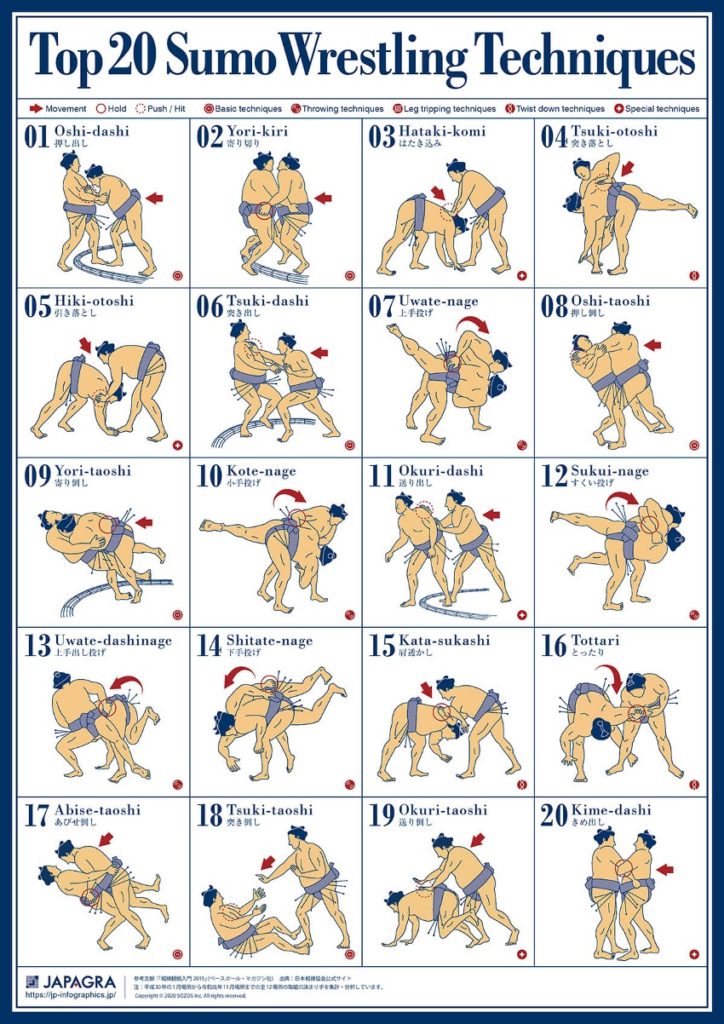
- Oshidashi (押し出し) – A front push-out. The wrestler pushes his opponent out of the ring by keeping his hands on the opponent’s body or chest without fully extending his arms.
- Yorikiri (寄り切り) – A frontal force-out. The wrestler grabs the opponent’s belt (mawashi), maintains a firm grip, and drives them out of the ring.
- Hatakikomi (叩き込み) – A slap down. The wrestler slaps the opponent’s shoulder, back, or arm, forcing them to fall to the clay surface.
- Tsukiotoshi (突き落とし) – A thrust down. The wrestler pushes against the opponent’s upper body, twisting them off-balance and forcing them to fall to the dohyo.
- Hikiotoshi (引き落とし) – A pull down. The wrestler pulls the opponent by the belt, arm, or shoulder, forcing them to fall forward.
- Tsukidashi (突き出し) – A frontal thrust-out. The wrestler pushes the opponent out with a series of rapid hand thrusts to the chest or body. Maintaining constant hand contact is not necessary.
- Uwatenage (上手投げ) – An overarm throw. The wrestler reaches over the opponent’s arm, grabs their belt, and throws them to the ground by turning sideways.
- Oshitaoshi (押し倒し) – A front push-down. The wrestler pushes his opponent down onto the clay within the ring while maintaining hand contact throughout.
- Yoritaoshi (寄り倒し) – A frontal crush-out. The wrestler grips the opponent’s belt, forces them out of the ring, and causes them to collapse onto their back. Also known as a front crush-out.
- Kotenage (小手投げ) – An armlock throw. The wrestler grabs the opponent’s extended arm, wraps around it, and throws them to the ground without holding the belt.
- Okuridashi (送り出し) – A rear push-out. The wrestler pushes an off-balance opponent out of the ring from behind.
- Sukuinage (掬い投げ) – A beltless arm throw. The wrestler goes under the opponent’s armpit, across their back, and turns sideways to throw them forward to the ground.
- Uwatedashinage (上手出し投げ) – A pulling overarm throw. The wrestler reaches over the opponent’s arm or back to grab their belt while pulling them forward to the ground.
- Shitatenage (下手投げ) – An underarm throw. The attacker gets under the opponent’s arm, grabs their belt, and turns sideways to pull the opponent to the ground.
- Katasukashi (肩透かし) – An under-shoulder swing. The wrestler wraps both hands around the opponent’s arm, grabs the shoulder, and forces them down.
- Tottari (とったり) – A tight armlock throw. The wrestler wraps both arms around the opponent’s extended arm and pulls him forward to the ground.
- Abisetaoshi (浴びせ倒し) – A crushing fall. The wrestler puts all their body weight onto an opponent who is bent over or off-balance, forcing them down.
- Tsukitaoshi (突き倒し) – A frontal thrust-down. The wrestler uses hand thrusts or shoves to down the opponent over the edge of the ring, causing them to fall onto their back.
- Okuritaoshi (送り倒し) – A rear push-down. The wrestler knocks down an opponent from behind with a push.
- Kimedashi (極め出し) – A force-out by clamping. The wrestler wraps up the opponent’s arms and shoulders, immobilizing them, and then pushes them out of the ring.
Trivia
Set Phrases and Announcements
- Standard Wrestler Introduction: The gyoji calls out, “(Wrestler’s name) and (Wrestler’s name).”
- Introduction for High-Ranked Wrestlers: For upper-ranked wrestlers, the gyoji announces, “This is (wrestler’s name), that is (wrestler’s name)” twice.
- Final Bout Announcement: Before the last match, the gyoji declares: “Today’s bouts have gone smoothly until we reached the last one. From this side, … and from that side, …, this bout is the end of today’s tournament.”
- Referee’s Encouragement: The gyoji shouts “Hakkeyoi!” (“Go all out!”) and “Nokkotta! Nokkotta!” (“You’re still in it! Don’t give up!”) to urge the wrestlers on.
- Bout Result: The result is announced as: “(Winning wrestler’s name) won by the winning technique of (technique name).”
- Audience Cheer: During ceremonial stomping, the audience shouts “Yoisho!”—an expression of exertion, similar to “Heave-ho!”
Rewards (Kensho)
Reward groups, such as companies or fan clubs, post cash prizes for bouts in the makunouchidivision. The total reward is 70,000 yen, of which 30,000 yen is given to the winner in a decorative envelope. Before a sponsored bout, callers parade around the ring displaying banners with the sponsors’ names.
The Gyoji (Referee)
Gyoji are ranked in a seniority system similar to the wrestlers. They wear the traditional attire of a Shinto priest, including eboshi headgear, a ceremonial robe, tabi socks, zori footwear, and carry a war fan (gunbai). They preside over the entire bout and point this fan toward the winner at its conclusion.
The Yobidashi (Caller/Attendant)
The yobidashi’s primary duty is to call the wrestlers’ names before their bouts. Their many other responsibilities include cleaning the dohyo, displaying sponsor banners, constructing the clay ring before the tournament, beating a drum to attract spectators, and notifying wrestlers of their preparation time.
The Dohyo (Ring) and Arena
The sumo ring is a 15-foot-diameter clay platform raised about 2.5 feet off the ground. The arena’s roof is designed in the style of a Shinto shrine. Historically, the roof was supported by four pillars, but these were removed in 1952 to improve the audience’s view. From the four corners of the roof hang tassels in red, black, white, and blue, representing the four cardinal directions and based on the ancient Chinese theory of Yin and Yang.
Sumo Data 細かいデータはここに書いてあります。