Dazaifu was a critically important administrative center in ancient Japan, functioning as the government’s head branch office in Kyushu. This was due to its location, which was the closest to the Asian mainland.
However, 1200 years ago, the scholar and statesman Sugawara no Michizane was exiled here, which fundamentally changed the site’s significance. Soon after his death, he was deified, and a shrine was built in his honor. Today, “Dazaifu” most commonly refers to this Dazaifu Tenmangū Shrine.
More about Shinto Shrine , Click here.
More about Tenman Shrine , Click here.
1 Dazaifu Shrine
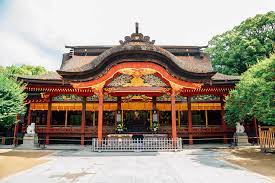
Dazaifu Tenmangū is the most popular sightseeing spot in Fukuoka. It enshrines Tenman-Tenjin, the deified spirit of Sugawara no Michizane, who is revered as the God of Learning. Within the precincts, visitors can see statues of oxen (considered his divine messengers), a statue of a Kirin (a mythical creature), an iris pond, and massive camphor trees.
To enhance your experience, you may wish to follow traditional Japanese shrine etiquette, such as purifying your hands and mouth at the chozuya and praying in the customary manner. The path approaching the shrine is lined with numerous snack and souvenir shops. The most distinctive landmarks along this walk are the shops selling Umegae-mochi (the local rice cake specialty) and a uniquely designed Starbucks coffee shop.
English Official Site : Dazaifu Shrine https://www.dazaifutenmangu.or.jp/en/
2 Michizane Sugawara
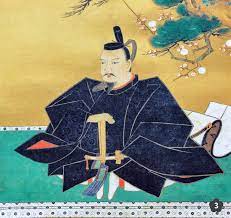
Sugawara no Michizane lost his position due to a political scheme by his rivals, was exiled to Dazaifu, and died there in deep sorrow. Some years after his death, a series of tragic deaths and disasters struck the imperial capital of Kyoto. The people believed these calamities were the work of Michizane’s vengeful spirit, knowing of his unjust end and feeling a need to appease his anger. To pacify his soul, they enshrined him as a deity, which led to the construction of Dazaifu Tenmangū.
3 Torii Gate
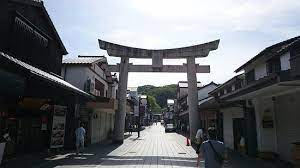
A torii is a traditional Japanese Shinto gate. Its name literally means “where a bird is,” though the exact origin of the term is uncertain. Typically made of wood or stone, it consists of two vertical pillars supporting two horizontal crossbars at the top.
The torii marks the boundary between the ordinary world and the sacred ground of the shrine. It is customary for visitors to bow slightly before passing through it upon entering. After visiting the shrine, they will often turn back and bow again after walking through the gate to show respect.
Many torii are painted in a vibrant red-orange color. In Japanese culture, this color is believed to ward off evil spirits, as it is associated with the life-giving powers of the sun and fire, symbolizing vitality and protection.
4 Starbucks
You will find a Starbucks coffee shop along the approach to the shrine. However, this is no ordinary location; it was designed by the renowned architect Kengo Kuma. He has imbued the shop with a traditional Japanese aesthetic, featuring an intricate lattice of wooden joints.

5 Ukiddo with a modern art work
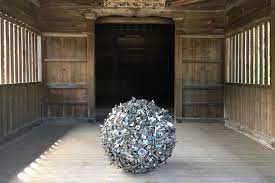
Ukidono is a Japanese-style garden featuring a structure that appears to float on the water. It displays modern art, a personal interest of the current chief priest, or Guji.
6 Ox Statues and Ox Cart
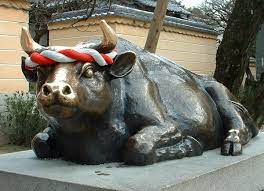
In the Heian period, aristocrats were transported in carriages drawn by oxen. According to legend, after Michizane Sugawara passed away in Dazaifu, his disciples placed his body on an oxcart. During the procession, the ox suddenly stopped and lay down, refusing to move further. The disciples interpreted this as a divine sign from their late master, indicating this was the proper resting place. His body was buried on that spot, and a shrine was later constructed over it, which evolved into the present-day Dazaifu Tenmangū.
Within the shrine precincts, there are eleven statues of oxen. The first one encountered when approaching the main hall is a black, reclining ox. It is said that stroking its head will make you wiser.
7 Taikobashi Bridges
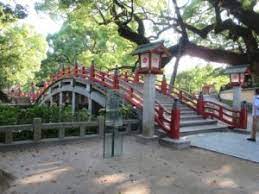
The pond beneath the bridges is shaped like the kanji for “heart” or “spirit” (心). The three bridges spanning it symbolize the past, present, and future, and crossing them is meant to purify one’s soul through these three stages of time. According to one belief, you should not look back while crossing the first bridge (the past), you should not stop on the second (the present), and you should not stumble on the third (the future).
8 How to wash your hands
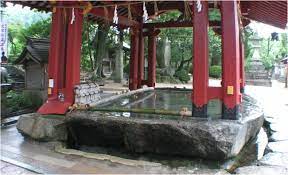
The Purification Process (Temizu):
Finally, gently raise the ladle vertically to let the remaining water rinse the handle before placing it back.
- 1 Take the ladle with your right hand, fill it with water, and rinse your left hand.
2 Transfer the ladle to your left hand and rinse your right hand.
3 Switch the ladle back to your right hand, cup your left palm, and pour water into it to rinse your mouth. (Do not put the ladle directly to your lips.)
4 Rinse your left hand again by pouring water over it.
In Shinto practice, physical purity is associated with spiritual purity. Originally, this involved a full ritual bath called misogi. However, as this is impractical for daily visitors, the practice has been simplified to a symbolic cleansing of the hands and mouth at a fountain known as a chōzuya or temizuya.
This ritual, called temizu, is the essential act of purification before approaching the shrine to pray. By performing it, you are considered spiritually prepared for your visit.
More about Cyozuba and Altars , Click here.
9 How to pray in front of the main pavilion
The Prayer at the Hall (Haiden):
After purification, proceed to the offering hall. The standard prayer ritual is as follows:
- Throw a small coin into the offering box.
- Bow deeply twice.
- Clap your hands twice.
- With your hands together, offer a silent prayer.
- Finish with one final deep bow.
This structured approach ensures you follow the traditional etiquette respectfully.
10 Flying Plum Tree
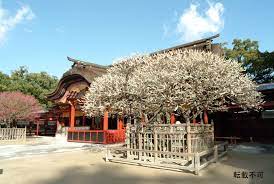
Tobiume literally means “Flying Plum Tree.” According to legend, when Sugawara no Michizane was exiled to Dazaifu, a plum tree from his home garden in Kyoto was so devoted to him that it flew through the night to be by his side. This tree is now enshrined in front of the main hall. Because of this story, the plum blossom became the symbol of Dazaifu Tenmangū—as seen in many of its designs and patterns—and is also the official flower of Fukuoka Prefecture.
11 Fortune Telling Paper
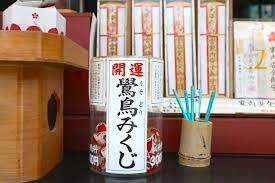
An omikuji is a paper fortune slip found at almost every Shinto shrine and Buddhist temple in Japan, typically for a small donation of around 100 yen.
To receive one, you pick a numbered stick from a box and exchange it for the corresponding paper slip, or sometimes draw the paper directly. The fortune first displays a large kanji character indicating your overall luck, followed by detailed predictions for various aspects of life like wealth, health, love, and career.
If you receive “大吉” (daikichi), meaning “Great Blessing,” it is considered very fortunate, and you should keep the paper with you for good luck. If the fortune is less favorable, the custom is to tie the paper slip to a designated tree, rope, or rack near the omikuji area. This symbolic act is believed to leave the bad fortune behind.
12 Praying Board
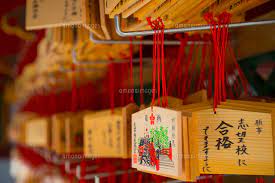
An ema is a small wooden plaque used for writing prayers. People write their wishes and their names on it and then hang it on a designated rack at a shrine or temple.
The content of the wishes typically relates to the specialty of the shrine. As Dazaifu Tenmangū is dedicated to the god of learning, the vast majority of plaques here feature prayers for academic success, such as “Please let me pass my entrance exam” or “Help me get better grades.”
13 Hyotan Gourd
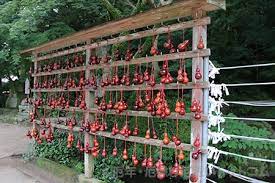
A hyotan is a gourd with two bulges, a smaller one on top and a larger one on the bottom. In Japan, it is considered a lucky charm. Its shape symbolizes growth and progress—starting small and expanding to achieve great success.
14 Tall Camphor Trees
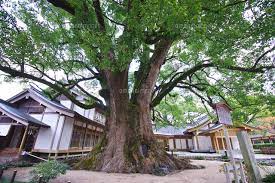
Camphor trees are commonly found in Shinto shrines and Buddhist temples throughout Japan. Especially in the warmer climate of Western Japan, some have grown to immense sizes over hundreds of years. These ancient trees are often revered as sacred. One reason for their holiness is the camphor extracted from their wood, which was historically used to repel insects; this protective quality led to the belief that the trees could also ward off evil spirits. A prominent example is the great camphor tree at Dazaifu Tenmangū, which stands 33 meters high, is over 300 years old, and is designated as a National Natural Monument.
More about Camphor , Click here.